Free tool
Intermittent fasting calculator
Pick a fasting schedule and your first meal, and see exactly when to start and break each fast.
Your daily windows
Eat between 12:00 PM and 8:00 PM.
Then fast for 16 hours, until 12:00 PM the next day.
Eating window
8hours
Fast length
16hours
Last bite by
8:00 PM
What happens during the fast
Rough guide from your 8:00 PM cut-off. Timings shift with your last meal, activity, and metabolism.
- 0h
Fast begins8:00 PM
Your last meal is still being digested and blood sugar is elevated.
- 4h
Back to baseline12:00 AM (next day)
Digestion wraps up and insulin starts falling toward its baseline.
- 8h
Running on stores4:00 AM (next day)
Your body works through stored liver glycogen for most of its fuel.
- 12h
Switching fuel8:00 AM (next day)
Glycogen runs low and fat becomes a larger share of the mix.
- 16h
Fat metabolism rises12:00 PM (next day)
Ketone production picks up. This is where 16:8 ends its fast.
Estimates, not medical advice. This calculator does clock arithmetic and describes general physiology. It cannot account for your medications, blood sugar, pregnancy, or medical history. Intermittent fasting is not appropriate for everyone — see the last question below.
How to use this calculator
Pick the fasting schedule you want to follow and set the time you intend to eat your first meal. Everything else follows from those two numbers: when your eating window closes, when the fast starts, and when you can eat again.
Most people find it easier to anchor on their first meal rather than their last, because that’s the one you control most reliably. Dinner tends to move with social plans; the decision to skip breakfast is yours alone.
What the schedules mean
- 14:10 — 14 hours fasting, 10 hours eating. The gentlest version, and close to what many people do accidentally.
- 16:8 — the most common schedule by a wide margin. Typically noon to 8pm, which means skipping breakfast rather than skipping dinner.
- 18:6 — a step up. Usually two meals in a six-hour window.
- 20:4 — sometimes called the Warrior Diet. One main meal plus a small second one.
- OMAD — one meal a day, roughly a 23-hour fast. Getting adequate protein and micronutrients in a single sitting is genuinely hard.
Why the timeline is approximate
The hour-by-hour view above is a general picture, not a measurement of you. How quickly you move from burning glucose to burning fat depends on what your last meal contained, how much you move during the fast, how much muscle you carry, and how long you’ve been fasting regularly. Someone who eats a large pasta dinner and sits still enters the fat-burning phase considerably later than someone who ate a small protein-heavy meal and walked the next morning.
Treat the milestones as a map of the general terrain, not a schedule your body is contractually obliged to follow.
Making a schedule stick
The schedule that works is the one that survives a normal week. A 16:8 window you keep six days out of seven beats a 20:4 window you abandon on day four. Two practical notes:
- Put the cut-off time somewhere you’ll see it. Most people break a fast by forgetting when it started, not by deciding to break it.
- Watch what you eat inside the window, not just when. A shortened eating window naturally reduces intake for most people, but it isn’t magic — you can comfortably out-eat an 8-hour window.
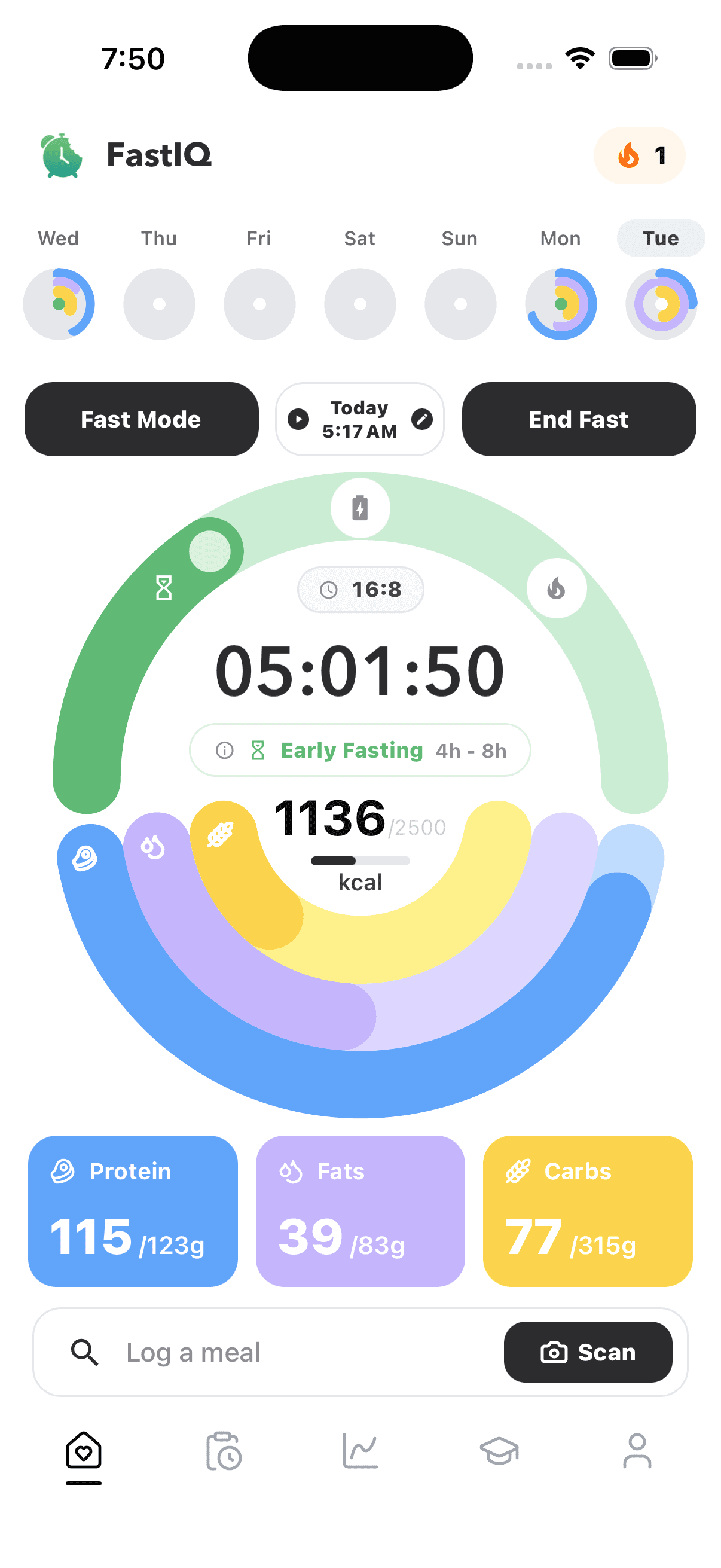
If you want both halves handled, that’s the point of the app: the timer runs itself, and photographing a meal logs the calories and macros. You can also work out your daily calorie target to know what the window should hold.
Common questions
What is the best intermittent fasting schedule to start with?+
16:8 is the usual starting point: a 16-hour fast and an 8-hour eating window, which for most people means skipping breakfast and eating between roughly noon and 8pm. If 16 hours feels like too much at first, 14:10 is a gentler on-ramp and still shifts most of your eating into a defined window.
Does coffee break a fast?+
Black coffee, plain tea, and water contain effectively no calories and are generally considered fine during a fast. Adding milk, cream, sugar, or sweetened syrups adds calories and will end a strict fast. If your goal is simply eating less overall, a splash of milk matters far less than most people assume.
When should I stop eating if I want to fast 16 hours?+
Count back 16 hours from when you want your first meal. If your first meal is at noon, your last bite is at 8pm the evening before. The calculator above does this for you and shows the exact cut-off time for whichever schedule you pick.
Can I drink water while fasting?+
Yes, and you should. People often mistake thirst for hunger during a fast, and skipping the water that normally comes with meals makes dehydration easy. Water, sparkling water, black coffee, and plain tea are all fine.
Who should not try intermittent fasting?+
Fasting is not appropriate if you are pregnant or breastfeeding, have a history of disordered eating, are under 18, or are underweight. If you take medication that must be dosed with food, or manage diabetes, talk to your doctor before changing when you eat.
Stop doing the math
The timer knows your window.
Set the schedule once and Fastiq counts it down, tells you when to eat, and lets you fix the times when real life gets in the way.