Fasting schedules
How long should you fast? A guide to every common window
Compare 12:12, 14:10, 16:8, 18:6, 20:4, and OMAD — what each schedule asks of you, who it suits, and why longer isn't automatically better.
The useful answer is usually shorter than the internet suggests. For a beginner, 12 to 14 hours overnight is enough to create a real boundary. For someone who already fasts comfortably, 16 hours may fit. Beyond that, the schedule becomes harder faster than the evidence becomes stronger.
A fasting window should solve a problem — late-night snacking, constant grazing, or a day with no clear meal structure. “As long as possible” is not a goal.
The common fasting windows compared
| Schedule | Example fast | Typical meals | Difficulty | Best use |
|---|---|---|---|---|
| 12:12 | 8pm–8am | 3 meals | Gentle | Stopping after-dinner eating |
| 14:10 | 8pm–10am | 2–3 meals | Moderate | A sustainable first fasting routine |
| 16:8 | 8pm–noon | 2 meals + snack | Moderate | A clear daily boundary |
| 18:6 | 7pm–1pm | 2 meals | Demanding | People already comfortable at 16:8 |
| 20:4 | 7pm–3pm | 1–2 meals | Hard | Limited situations; nutrition gets harder |
| OMAD | One daily meal | 1 meal | Very hard | Usually not a first-line routine |
12:12: the overlooked starting point
Twelve hours might mean dinner ends at 8pm and breakfast starts at 8am. It does not require skipping a meal. Its value is behavioral: the gap closes the kitchen after dinner and removes a long evening of optional calories.
Choose 12:12 if you currently snack late, have never fasted on purpose, train early, or need food with morning medication. If it solves the problem, you do not have to “graduate” from it.
14:10: the practical middle
Fourteen hours is enough to feel like a schedule but wide enough to fit breakfast and dinner. A 9am–7pm or 10am–8pm eating window often works without much social disruption.
This is a strong default for beginners. In a small randomized trial, both 12-hour and 14-hour overnight schedules were paired with weight loss, although the program also controlled calories and included exercise support. In other words, 14:10 can be useful, but the clock was not acting alone.
16:8: popular for a reason
Sixteen hours usually removes breakfast or dinner and leaves room for two meals plus an optional snack. It is strict enough to reduce eating opportunities while still fitting ordinary food into the day.
Research on 16:8 is mixed. Some trials find modest weight loss; others find no meaningful advantage over a regular meal pattern when calories are comparable. That makes 16:8 a tool for consistency, not a special metabolic threshold. See the full 16:8 schedule guide for example windows and a gradual setup.
18:6: a smaller window with bigger tradeoffs
An 18-hour fast leaves six hours for eating, commonly 1pm–7pm. This can work for people who naturally prefer two larger meals and already find 16:8 easy.
The costs are practical. Protein, fiber, fruit, vegetables, and enough total energy must fit into fewer meals. Training recovery can become awkward. The first meal may grow so large that the shorter window no longer reduces daily intake. If 18:6 makes food dominate your attention, step back.
20:4 and OMAD: longer is not automatically better
A four-hour window and one-meal-a-day schedules are difficult places to get enough protein, micronutrients, and fiber. One very large meal can also be uncomfortable. These approaches add restriction, but we do not have strong evidence that they produce better long-term results than more moderate windows.
Longer fasts are especially easy to romanticize with claims about autophagy. Autophagy is a real cellular process, but human research does not give us a precise household clock at which it suddenly “switches on.” A speculative benefit is not a good reason to ignore sleep, training, medication needs, or signs that you are under-fueling.
How to choose your number
- Name the problem. If it is evening snacking, 12:12 may fix it. If it is all-day grazing, 14:10 or 16:8 creates a clearer edge.
- Protect the meal that matters. Keep family dinner, an early breakfast, or a meal around training inside the window.
- Use the least restrictive effective option. Do not spend nutrition and social flexibility without getting something useful in return.
- Run a fair test. Repeat the window for two to four weeks before deciding, unless you feel unwell.
- Adjust one step at a time. Move by one or two hours, not from 12:12 directly to OMAD.
The intermittent fasting calculator turns any first- or last-meal time into the matching 12:12 through OMAD schedule.
Signs your fasting window is too long
- You repeatedly feel dizzy, faint, weak, or unable to concentrate.
- You overeat or feel out of control when the window opens.
- Your training performance and recovery keep deteriorating.
- You cannot fit balanced meals and enough protein into the window.
- The plan isolates you from meals you value.
- You are preoccupied with making the fast increasingly strict.
Shorten the fast if these patterns appear. A schedule is supposed to reduce food decisions, not take over more of them.
What about 24-, 36-, or 48-hour fasts?
Multi-day and full-day fasts are different from a daily overnight schedule. Risks such as dehydration, medication problems, low blood sugar, and inadequate intake become more important. They are not necessary to practice time-restricted eating or lose weight, and they are not something to improvise based on a timer app.
Who should not experiment with longer fasts. Avoid fasting if you are pregnant or breastfeeding, under 18, underweight, or have a history of disordered eating. If you have diabetes, a relevant medical condition, or medication that interacts with meal timing, work with your clinician. Stop a fast if you feel faint, confused, persistently weak, or unwell.
The bottom line
Start at 12:12 or 14:10. Use 16:8 if skipping one meal feels natural and the shorter window improves your day. Treat 18:6 as an optional progression, not a requirement. For most people, 20:4 and OMAD trade away more flexibility than they return in proven benefit.
Sources
Stop doing the math
The timer knows your window.
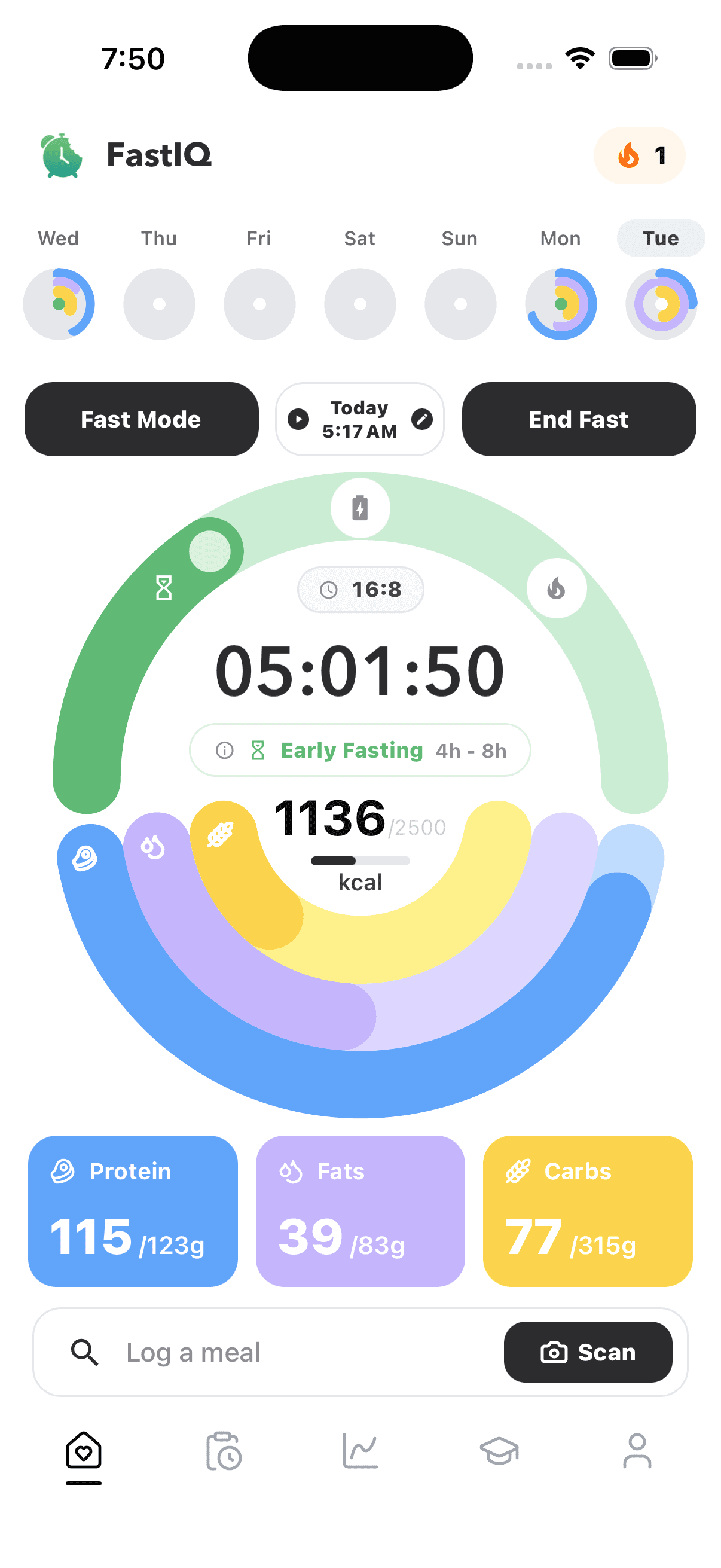
Set the schedule once and Fastiq counts it down, tells you when to eat, and lets you fix the times when real life gets in the way.